Callirhoe species (winecups or poppy-mallows)
Callirohe involucrata
I love this plant. Very enthusiastic.
Quick start
- Sun to part shade (fewer flowers)
- Dry to moist (they just get bigger)
- Will die back completely in summer heat, leaves re-emerge in fall and winter
- If planting seeds
- 30 days of cold, whether via outdoors (fall sowing) or fridge
- To speed cracking the seed coat, pour boiling water over the seeds then let soak in the cooling water for a day
- Press into soil surface, do not bury
- Can be mowed if escapes into lawn or you sprinkle in lawn
How to grow
Draft! Some links will not work! Need to write more!
From seeds
- Cold stratification: 30 days
- Fridge tested? yes
- Freezer tested? no
- Scarification: boiling
- Soaking needed? 24 hours of soaking in the water as it cools from poured boiling over seeds
- Light needed (if yes, don’t cover): yes?
- Germination season in wild? late summer into winter
- Storage life? number
- How to tell when seeds ripe? tan and the seedhead breaks apart
- Native Plant Network Propagation Protocol
How many plants to make seeds?
- Can self (need more than one to make viable seeds): unknown
- Separate male and female flowers on different plants: no
From plants
Details about dividing or planting that are beyond the points below.
- Diggable: only when 1-2 adult leaves or in very loose soil (such as potting soil or damp sand)
- Root type: taproot
- Divisible: no
- Recovers from root cut: only if minor
- Life span: long-lived perennial
- Runners (stolons): no
- Underground (rhizomes): no
- Clump-forming: no
- Vogt sociability rating: 3
Where they live
Moisture
- Dry: yes
- Medium dry: yes
- Average: yes
- Medium wet: yes
- Wet: yes
- Aquatic: no
- Winter flooding: yes
- Spring flooding: yes
- Winter drought: yes
- Summer drought: yes
- Drought reaction: dies back to root
Light
- Full shade: no
- Part shade: yes
- Full sun: yes
Soil types
- Sand: yes
- Loam: yes
- Clay: yes
- Shallow:
- Containers: yes
- Rocky: yes
- Gravel:
- Potting soil: yes
- Well drained: yes
- Poorly drained: subject to rust-disease if too wet
- Nutrient rich: yes
- Nutrient poor: yes
- Calcareous: yes
- Acidic: yes
- Alkaline: unknown
Disturbance
- Stepping on: yes
- Mowing: yes regularly
- Cut flower use: yes, for several days in water
- Deer resistant: no
- Rabbit resistant: presumed no from deer
- Earwig resistant: yes
Thatch and leafy layers
- Doesn’t seem to be able to germinate with many layers of leaves, so plant in areas where some bare ground is available
- Once established, can emerge through 1 to 3 inches of loose leaves (woodland edge but not full woods)
Temperature
This is not a species I worry about covering adult plants (or outdoor-sprouted seedlings) in the winter.
- Lowest temperature recorded for adult plants (including rosettes) without damage (F): not recorded (covered)
- Lowest temperature recorded for adult plants (including rosettes) without damage (F): 4 (uncovered)
- Lowest temperature recorded for adult plants (including rosettes) with damage (F): not yet reached (covered)
- Lowest temperature recorded for adult plants (including rosettes) with damage (F): not yet reached (uncovered)
Interactions with other plants
Can coexist easily with
- Native species
- Oenethera speciosa
- Little Bluestem
- Salvia greggii
- Mimosa quadrivalis
- Teucrium canadense
- Salvia azurea
- Artemisia ludoviciana
- Rudbeckia hirta
- Ratibida columnifera
- Rattlesnake Master
- Solidago rigidiscula
- Camassia species (ephemeral)
- Invasive or introduced species
- bermudagrass
- crabgrass
Even in ideal habitat, can be outcompeted by
- Native species
- Helianthus maximiliani
- Sorghastrum nutans
- Big Bluestem
- Solidago altissima
- Solidago canadensis
- Sumac species (such as Rhus copallinum)
- Vernonia baldwinii
- Datura wrightii (when it’s not too wet for the Datura)
- Invasive or introduced species
- Johnsongrass
- Autumn clematis
- Introduced Wisterias
In its ideal habitat, this species can outcompete
For most of these, winecups can coexist in drier habitats where the winecups are smaller, or if mowing occurs.
- Native species
- Buffalograss
- Linum pratense
- Tetraneuris linearifolia
- Claytonia virginiana
- Salvia lyrata
- Blue-eyed grass
Can this plant tolerate allelopathy by
- Black walnut: unknown
- Pines: unknown
- Eastern red cedars: unknown
- Introduced disruptive species:
- Tree of heaven: unknown
- Bradford pears: unknown
- Garlic mustard: unknown
Does it need neighbors?
- Parasitic plant? no
- Will flop without neighboring plants or support? no, it sprawls on ground on its own
Where can I get?
- Ask a neighbor if they have any!
- Dig existing seedlings in late summer to early winter before the taproot gets too big
Plants (potted or bare roots)
Oklahoma
- Lia’s Garden (Oklahoma City)
- Blue House Urban Farms (Oklahoma City), usually, contact nursery to confirm
- Prairie Flora Co (Oklahoma)
- All Tomorrow’s Prairies, Creek County Oklahoma ecotype specified
- Native Plant Nursery (Oklahoma City)
- Prairie Wind (Purcell)
- Mann’s Greenhouses (Pollinators and Prairies)(Oklahoma City)
- Bustani Plant Farm(Stillwater)
Within one state
More than a state away
Seeds
Oklahoma
- None to my knowledge
Within one state
More than a state away
Find more photos and information
- North Carolina Extension Service
- Missouri Botanical Garden
- Lady Bird Johnson Wildflower Center
- Wildflower Search
- Native Plant Network Propagation Protocols
- Arkansas Native Plant Profiles
- Calscape Profile
- Grow Native! Profile
- OSU Extension Service Profile
- NPSOT Profile
- Central Texas Gardener
- Kansas Wildflowers and Grasses
- Wikipedia
- Flora of North Central Texas Flora, page 807
- North Central Texas Wildflowers Field Guide page number 303 Curry (2023)
- Flora of Oklahoma, 3rd Edition, page 198
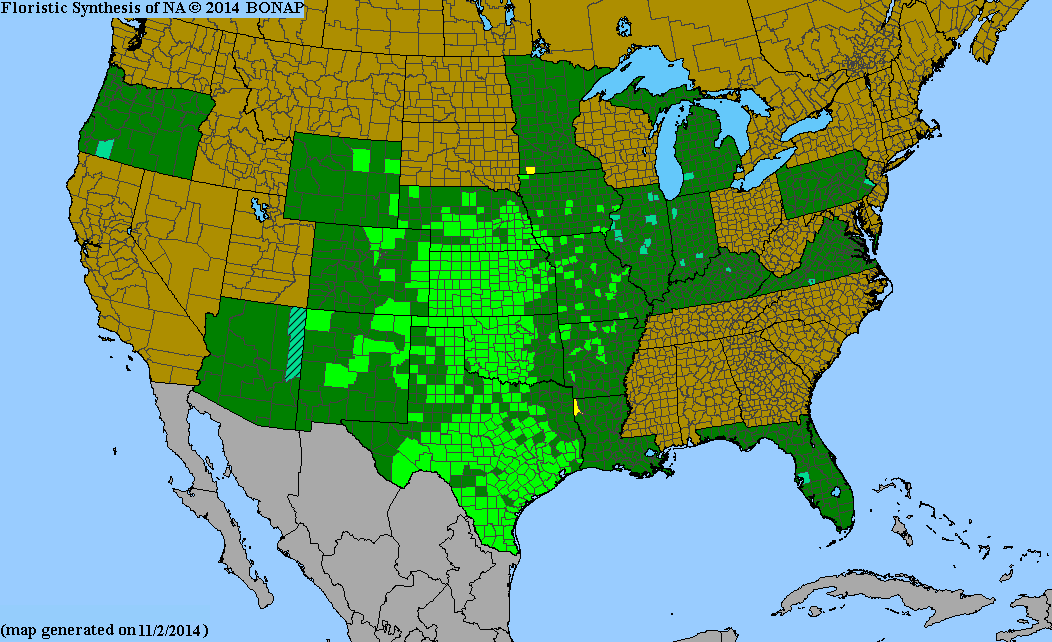
- BONAP map
Other species
bushii digitata leiocarpa pedata
What is the ecosystem function…
in Oklahoma?
in general?
- Bugguide.net search for “PLANT NAME” in images, guide pages, and comments
- HOSTS Data Portal search for “PLANT NAME”
- Encyclopedia of Life(most contain food web illustrations)
- Or individual species links if this page covers a genus with multiple species
References
Curry, Mary. 2023. North Central Texas Wildflowers. Second edition, online. Decatur, Texas, USA: Self-published.